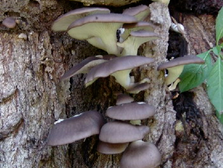
Many types of mushrooms are suitable for growing on fresh wood. Japanese toothwort (shiitake) and beech oyster mushrooms are the easiest to grow, as they are among the less demanding. However, most mushrooms that grow naturally on wood (stumps, branches, trunks of dead or dying trees) can be cultivated. Among the edible mushrooms, in addition to oyster mushrooms(Pleurotus sp.) and shiitake mushrooms(Lentinula edodes), it is also possible to cultivate winter hawkweed(Flammulina velutipes), poplar mushrooms(Agrocybe aegerita), light-flowered hawkweed(Ganoderma lucidum), and other mushroom species (Flammulinavelutipes, Flammulina velutipes, Flammulina velutipes). Of all the mushroom cultivation methods, cultivation on fresh wood is the simplest, as this method does not require sterilisation of the substrate, which is essential for other cultivation methods. Logs from freshly felled trees and their stumps are suitable for mushroom cultivation, but must not be cracked. The hives must not be drained of sap, as the mycelium often rots. If sap is oozing from the hive, it is best to wait a few weeks for the hive to dry out. The bark should be intact, as intact bark prevents moisture from evaporating from the trunk, thus providing ideal conditions for the mycelium to grow, and also prevents other unwanted fungi from gaining access to the wood.
Hard hardwoods (oak – for shiitakes, beech, hornbeam, maple, alder, etc.) are the most suitable, as they yield the highest yields (beech wood yields twice as much as oak wood). Softer woods decay more quickly and yield lower yields. Softwood is only suitable for growing certain types of mushrooms because of its specific composition.
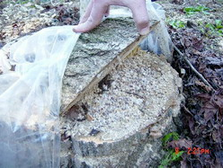
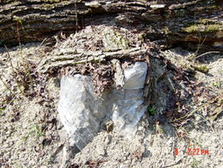
The hive can be drilled around the entire circumference in a zig-zag pattern and the mycelium on wooden pegs can be inserted into the holes. Alternatively, it can be cut widthwise, the entire surface sprinkled with mycelium on cereal grains and covered with a cut wooden dowel. The hive prepared in this way must be protected from drying out, direct sunlight and animals that feed on the mycelium by covering it with plastic sheeting and soil or leaves. On average, mycelium needs a few months to outgrow the substrate.
When white circles are seen on the cut surface of the hive, the hive is overgrown with mycelium and the polythene film and soil can be removed, but it is often better to leave it partially covered. When the weather conditions become favourable (usually in autumn), fungi start to grow out of the hive. The fungi grow until the wood is completely decomposed, which can take several years. In the meantime, it is necessary to ensure a humid environment without direct sunlight and strong draughts.
This method can be used to turn unwanted hives in gardens into mushroom ‘gardens’ for a few years, producing a few kilos of mushrooms and turning them into humus.
Treat yourself to a 5% discount on a mushroom wellness dose and join the GOBA community!
For those who want not just quick fixes, but lasting balance. For those who understand that health is not a goal, but a way of life. For those who are not just looking for a nutritional supplement, but a companion on the road to wellness. Because sometimes the smallest things make the biggest changes. A 5% discount is waiting for you when you make your first purchase – as a small thank you for your trust.
Treat yourself to a 5% discount on a mushroom wellness dose and join the GOBA community!
For those who want not just quick fixes, but a lasting balance. For those who understand that health is not a goal, but a way of life. Those who are not just looking for a dietary supplement, but a companion on the road to wellness. Because sometimes the smallest things make the biggest changes. A 5% discount awaits you on your first purchase – as a small thank you for your trust.